Choosing an industrial chiller is not simply a matter of selecting a capacity in tons. Two applications with the same nominal tonnage may require very different equipment once water temperature, flow rate, operating hours and site conditions are considered.
In the UAE, high temperatures, dust and outdoor installations place additional demands on chillers. An incomplete specification may result in inadequate cooling, repeated trips or installation difficulties.
A reliable chiller specification therefore begins with the actual application—not the model number.
1. Define the application
First, establish what the chiller must cool. It may serve process machinery, a production line, storage tank, accommodation facility, commercial building or another temperature-controlled system.
The supplier should know:
whether the requirement is for industrial process, comfort or domestic-water cooling;
what equipment or process produces the heat;
whether the water returns in a closed loop or is consumed;
whether the load is constant or variable; and
whether cooling is critical to production, equipment protection or occupant use.
2. Confirm the water temperatures and flow rate
Three figures are fundamental:
Entering water temperature: the temperature returning to the chiller.
Leaving water temperature: the required supply temperature.
Flow rate: the volume passing through the system, normally stated in m³/h, L/s or GPM.
The difference between the entering and leaving temperatures is the system’s ΔT.
This shows why tonnage cannot be chosen from temperature alone: high flow combined with a large temperature reduction can produce a much greater load than expected. Final selection must also consider the fluid, process behaviour and system heat gain.
3. Verify the real cooling load
Customers may begin with a requested size such as 10 TR or 40 TR, but that figure should be verified against the application.
The heat-load assessment may include:
process heat transferred into the water;
tank volume and starting temperature;
required pull-down time;
heat gain from tanks and pipework;
pump heat;
simultaneous operation of connected machines; and
expected future demand.
One refrigeration ton is approximately 3.517 kW of cooling, but nominal tonnage does not provide identical capacity at every water and ambient temperature. If a tank is involved, also define the required pull-down time.
4. Specify the UAE site conditions
For an air-cooled chiller, ambient air removes heat through the condenser coils. The design ambient and installation arrangement therefore affect available capacity and operating conditions.
Confirm:
the expected maximum temperature at the installation point;
whether the chiller will be in direct sunlight;
dust, sand, humidity or corrosive exposure;
clearance for air intake and discharge;
nearby walls or equipment that may restrict airflow; and
whether hot discharge air could circulate back into the condenser.
Writing only “suitable for UAE weather” is not specific enough. Capacity should be evaluated at the agreed site temperature, with condenser-coil access provided for cleaning in dusty locations.
5. Choose air-cooled or water-cooled
The correct configuration depends on the duty, site and available utilities.
Air-cooled chillers reject heat through condenser coils and fans. They can be practical where water use should be limited or a cooling tower is not preferred. Selection must consider ambient temperature, airflow, clearance and coil cleaning.
Water-cooled chillers use a condenser-water circuit that may include pumps, a cooling tower and water treatment. Water temperatures, quality, scaling and maintenance must be considered.
The decision depends on cooling duty, space, water availability, operating cost and maintenance capability.
6. Define the fluid, tank and piping system
Confirm whether the fluid is water or a water-glycol mixture, together with glycol concentration, process chemicals, water quality, food-grade requirements and freeze risk.
The hydraulic arrangement should also be reviewed, including:
tank dimensions and usable volume;
whether the tank is insulated and indoors or outdoors;
distance between the chiller, tank and machines;
pipe sizes, insulation and elevation changes; and
whether the system is open or closed.
Outdoor, uninsulated tanks and pipework add heat to the system.
7. Select the pumps correctly
A pump must provide the design flow against the total resistance of the circuit—not flow rate alone.
Account for pressure drop through the evaporator, pipework, valves, strainers and process equipment. Clarify whether a primary pump, circulation pump, duty/standby arrangement or integrated pump set is required, together with low-flow protection and interlocks.
8. Confirm operating hours, power and controls
State the daily working hours, peak and average loads and whether connected machines run together. Critical applications may require staged capacity or redundancy. Also confirm voltage, phase and frequency, along with temperature control, pump interlocks, flow switches, equipment protection, alarms, remote operation and any building or process-control integration.
9. Plan access, lifting and project scope
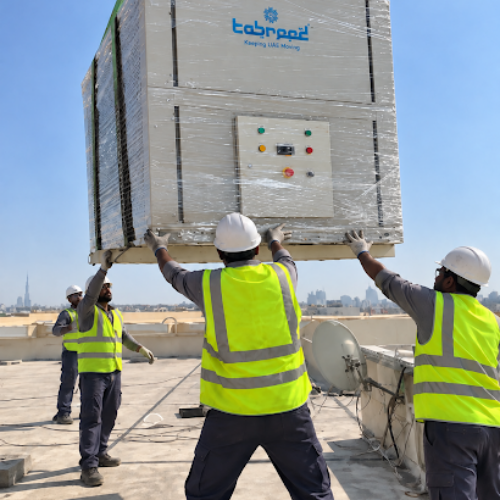
Check delivery routes, doors and gates, rooftop lifting requirements, structural support, safe lifting points and maintenance clearance.
The quotation should also define whether the scope covers supply only or includes:
chiller manufacture and assembly;
transportation and offloading;
lifting and positioning;
piping and electrical interfaces;
installation, testing and commissioning; and
operator handover and service support.
Define these responsibilities early to prevent gaps between the manufacturer, contractor and end user.
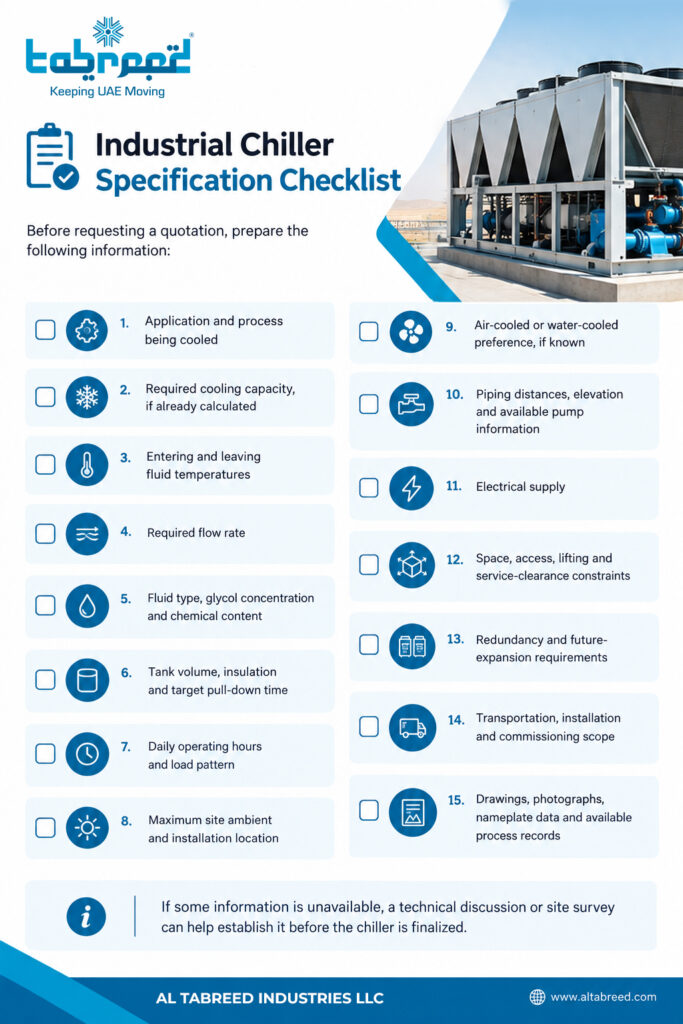
Access, lifting and service-clearance restrictions
Redundancy or future-expansion requirements
Transportation, installation and commissioning scope
Available drawings, photographs and operating records
How Al Tabreed supports industrial chiller projects
Al Tabreed Industries supports custom industrial chiller requirements for UAE and GCC applications. Our capabilities cover air-cooled and water-cooled chiller solutions, supported by in-house condenser-coil manufacturing and experience with replacement, refurbishment and retrofit requirements.
Our team reviews temperatures, flow, process load, installation conditions and project scope rather than selecting equipment from tonnage alone. Support can extend from manufacture and supply to transportation, installation and commissioning. This is especially useful for replacements with space or connection constraints, accurately matched condenser coils and technically assessed retrofits.
Conclusion
For UAE projects, chiller specification should go beyond nominal tonnage. Accurate temperatures, flow, heat load, site conditions, operating hours and installation requirements allow the manufacturer to design for the actual duty.
Planning a new industrial chiller, replacement or retrofit? Contact Al Tabreed Industries with your operating data, drawings or site details for a technical review.