The Most Common Causes of Coil Failure and How to Prevent Them
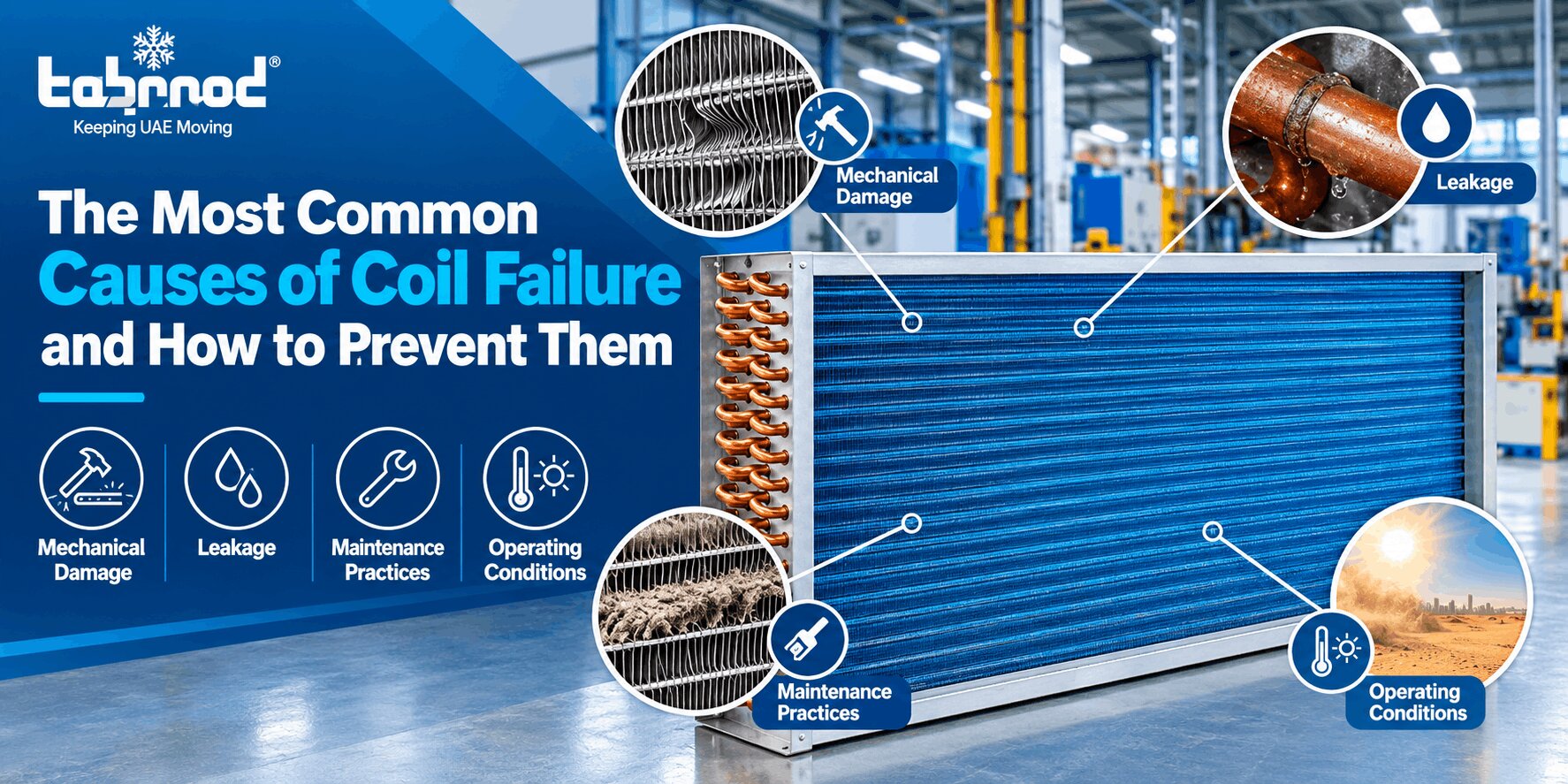
A coil rarely fails all at once – it fails slowly, through small stresses that stack up until the system can no longer keep pace & by the time someone notices reduced cooling or a spike in energy bills, the damage has usually been building for months.

Environmental exposure like sand, dust, and humidity gets a lot of attention in the Gulf, and rightly so, but four other factors quietly do just as much damage: mechanical damage, leakage, maintenance shortcuts, and the operating conditions the system is actually running under. 

Each one affects the coil directly, and each one eventually shows up as extra load on the compressor.

Mechanical Damage

Fins bend easily – a dropped pallet, a careless forklift pass, or a technician leaning a ladder against the coil face can crush dozens of fins in seconds. Bent fins block airflow across the coil surface, and reduced airflow means less heat transfer. The compressor has to work harder to move the same amount of heat, which raises head pressure and shortens compressor life over time.

Vibration is a slower version of the same problem. A unit that isn’t mounted securely, or one running on a compressor with worn isolators, transmits constant low-level shake into the coil assembly. Tubing & joints that flex repeatedly eventually fatigue, even if nothing looks visibly wrong on the outside.

The fix here is mostly procedural rather than technical. Fin guards during transport and installation prevent the easiest damage to avoid. Regular checks on mounting hardware and isolators catch vibration issues before they turn into cracked joints.

Leakage

Most coil leaks trace back to one of two things: a joint that was never brazed properly, or metal that’s been weakened by fatigue or corrosion until it finally gives way. Either way, the result is the same. Refrigerant charge drops, & ultimately the system can’t hit its rated capacity anymore.

This is where the coil and the chiller stop being separate problems. A slow leak doesn’t cause a sudden breakdown. It causes the compressor to run longer and harder trying to compensate for lost capacity…which increases wear on components that have nothing to do with the coil itself. A pinhole leak that seems minor on day one can meaningfully shorten compressor life by month six.

Routine leak detection, ideally with electronic detectors rather than a visual check alone, catches these early. Pressure testing after any maintenance work that involves the refrigerant circuit is worth the extra half hour it takes.

Also Read: How a Condenser Coil Is Manufactured: From Design to Final Testing

Maintenance Practices

Skipped cleaning is the most common cause of coil underperformance, full stop. 

Dirt and grease buildup insulates the coil surface the same way bent fins block airflow, just more gradually…the system keeps running, but it’s working harder for less output, and most operators don’t notice until the electricity bill forces the question.

Ironically – aggressive cleaning causes its own damage. High-pressure washing at the wrong angle bends fins just as effectively as a forklift does. Harsh chemical cleaners can attack coil coatings faster than the dirt they’re meant to remove. A gentler, more frequent cleaning schedule generally outperforms an infrequent deep clean.

Operating Conditions

This is where the GCC context matters most – separate from sand and dust exposure. Ambient temperatures across the region regularly push cooling systems to run at or near their design limits for months at a stretch. A coil that’s rated for a certain thermal range in a temperate climate is working at the edge of that range as standard practice here.

Long cooling seasons compound this. In many markets – systems get several months of light or no load where components can rest and be serviced without disrupting operations. Across much of the Gulf, that window barely exists. 

Units run near-continuously for most of the year, which means less natural downtime for the kind of inspection that catches problems early, and more cumulative thermal cycling on the coil and its joints.

Grid stability is a factor worth watching too…though it varies significantly by site and utility. Where voltage fluctuations or short outages are common, compressors can short-cycle more than they’re designed to, and that repeated stress transmits back through the connected coil circuit.

Also Read: How to Select the Right Condenser Coil for UAE Climate

Conclusion

Coil failure is rarely one dramatic event. It’s the accumulation of bent fins, a slow leak, a skipped cleaning cycle, and months of running near the system’s design limits without a break. Catching any one of these early is straightforward. Catching all four requires a maintenance approach built around how the system actually operates in this region…not a generic schedule imported from somewhere with a milder climate.

Al Tabreed designs condenser coils built for exactly these conditions, and our team can help you build a maintenance schedule that matches how hard your system actually runs.