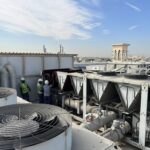
AI’s Growing Appetite for Cooling
As the world enters the era of Artificial Intelligence (AI), data centres are becoming the beating heart of digital infrastructure. But with this progress comes an enormous challenge – heat. AI-driven data centres consume immense amounts of energy and water to keep processors cool. According to Lombard Odier’s 2025 report, “Quenching Computing’s Insatiable Thirst,” global data centre capacity is expected to triple by 2030, while water-based cooling systems already consume millions of gallons per day in some facilities.
A recent feature in The Register (Jan 2025) reports that data centres in the US can consume between 300,000 and four million gallons of water a day, mostly for cooling. Some municipalities see data-centre demand account for up to 25 percent of total water use. The challenge isn’t limited to North America: across the globe, operators are questioning how to keep servers cool without draining local resources.
For industries in the UAE and Oman, where water scarcity already shapes infrastructure planning, this discussion is highly relevant. Whether we’re talking about district cooling, manufacturing plants, or power facilities, the principles of heat exchange and water management are the same.
Why Cooling Systems Need So Much Water
Water remains one of the most efficient ways to remove heat. In evaporative cooling towers, warm water from condensers is sprayed or trickled across fill media while fans pull air through. As the water evaporates, it removes heat – similar to how sweat cools the human body.
According to thermal-systems engineer Austin Shelnutt (cited by The Register), evaporating ten gallons of water per minute can dissipate roughly 1.5 megawatts of compute heat. That’s a huge cooling load – and a reason data-centre designers often favour water-based systems.
The problem? Up to 80 percent of the water entering a cooling tower is lost through evaporation or blow-down. In arid climates, replacement water must come from municipal or desalinated sources, adding both cost and environmental strain.
Why Waterless Cooling Isn’t Simple
While it might seem straightforward to switch to “dry” or air-cooled chillers, The Register article notes that energy efficiency is the trade-off. Evaporative systems deliver a Coefficient of Performance (COP) exceeding 1000, while dry coolers average around 12 and conventional refrigerant chillers 4.
That means air-cooled solutions consume far more electricity. And if that electricity comes from fossil-fuel-based grids, the indirect water footprint (used at power plants for steam generation) may still rise.
So, the real question isn’t simply “water or no water?” – it’s how to achieve balance between thermal performance, water conservation, and energy cost.
Adapting Cooling Design for GCC Conditions
1. Shell-and-Tube Heat Exchangers
Reliable and easy to service, these units are suited to industrial plants and district-cooling loops. Selecting corrosion-resistant alloys and optimizing flow velocities can extend lifespan when using high-salinity or treated-brine water.
2. Plate Heat Exchangers
Compact and efficient, brazed or gasketed plates provide excellent thermal transfer for closed-loop water systems. They can reduce total water demand by recycling chilled water without direct evaporation.
3. Air-Cooled Heat Exchangers
For remote sites and water-stressed areas, air-cooled exchangers eliminate the need for cooling-tower makeup water. Though fan power is higher, careful sizing and variable-speed drives can reduce energy peaks.
In data-centre or process-cooling applications, well-maintained condenser coils ensure proper heat rejection, reducing the temperature load on cooling towers or dry coolers. Closed-loop chillers can integrate both water-cooled and air-cooled sections for hybrid operation.
Emerging Practices Worldwide
Data-centre operators abroad are experimenting with several approaches that local industries can learn from:
- Free cooling and dry coolers in colder climates, using ambient air instead of evaporation.
- Closed-loop liquid (direct-to-chip) cooling, which relies on recirculated coolant rather than open water.
- Heat-recovery systems that redirect waste heat to nearby facilities or district networks.
- Water-aware load scheduling, routing AI workloads to facilities with low water stress or cooler nighttime temperatures.
While these solutions may not translate directly to the Gulf’s environment, their engineering logic – tighter monitoring, closed-loop efficiency, and precise control – absolutely applies.
Practical Takeaways for UAE and Oman Facilities
- Audit water and energy use together. A small efficiency gain in condenser performance can save thousands of litres daily.
- Upgrade to hybrid or air-cooled exchangers where water is expensive or supply is limited.
- Monitor blow-down and drift losses in existing towers; automated valves and TDS sensors can reduce waste by 10–15 percent.
- Use corrosion-resistant materials in shell-and-tube systems to safely reuse treated or brackish water.
- Explore modular closed-loop chillers for new facilities that need predictable cooling without heavy water dependence.
A Balanced Approach to Cooling
As The Register concluded, “datacenters are, with few exceptions, always going to use some amount of water.” The same applies to industrial cooling. The goal isn’t elimination but optimization — managing every litre and every kilowatt efficiently.
For companies in the UAE and Oman, the path forward lies in combining proven engineering — quality heat exchangers, condenser coils, and chillers — with smart control systems that balance water and energy use.
Al Tabreed Industries LLC supplies heat exchangers, condenser coils, air-cooled units, and chillers designed for high-ambient environments. Our products help industries maintain reliable cooling while addressing operational efficiency challenges unique to the region.
📩 Contact: info@altabreed.com | 🌐 www.altabreed.com
FAQ
Cooling systems—especially those using evaporative or water-cooled condensers—depend on water to absorb and remove heat from industrial or HVAC processes. The warmer the climate, the more evaporation occurs, leading to higher water usage.
Depending on system size and design, industrial-scale cooling systems or data centres can consume thousands to millions of gallons of water per day for heat rejection. This makes water efficiency an important consideration in arid regions like the UAE and Oman.
Air-cooled systems use ambient air to remove heat, requiring little or no water but more electrical energy for fans.
Water-cooled systems are generally more energy-efficient but rely on significant amounts of water for condensation or evaporation. The right choice depends on local conditions, water availability, and performance requirements.
Facilities can adopt air-cooled or hybrid heat exchangers, use closed-loop cooling to recycle water, maintain clean condenser coils, and upgrade to high-efficiency chillers that minimize water loss. Proper maintenance and design optimization can save both energy and water.
For the GCC’s hot and dusty climates, air-cooled heat exchangers and shell-and-tube systems with corrosion-resistant materials are most effective. They maintain heat-transfer efficiency while reducing dependence on freshwater.
Al Tabreed Industries LLC supplies a full range of heat exchangers, condenser coils, industrial chillers, and radiators, engineered for reliable operation in the UAE and Oman’s demanding conditions.
Contact: info@altabreed.com