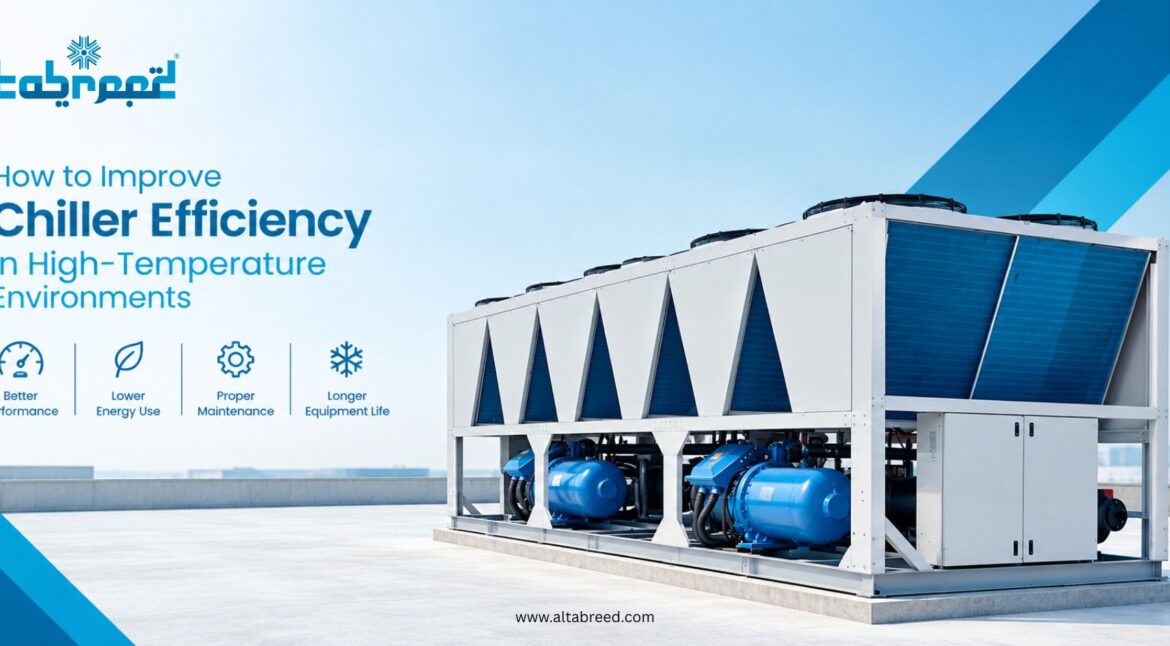
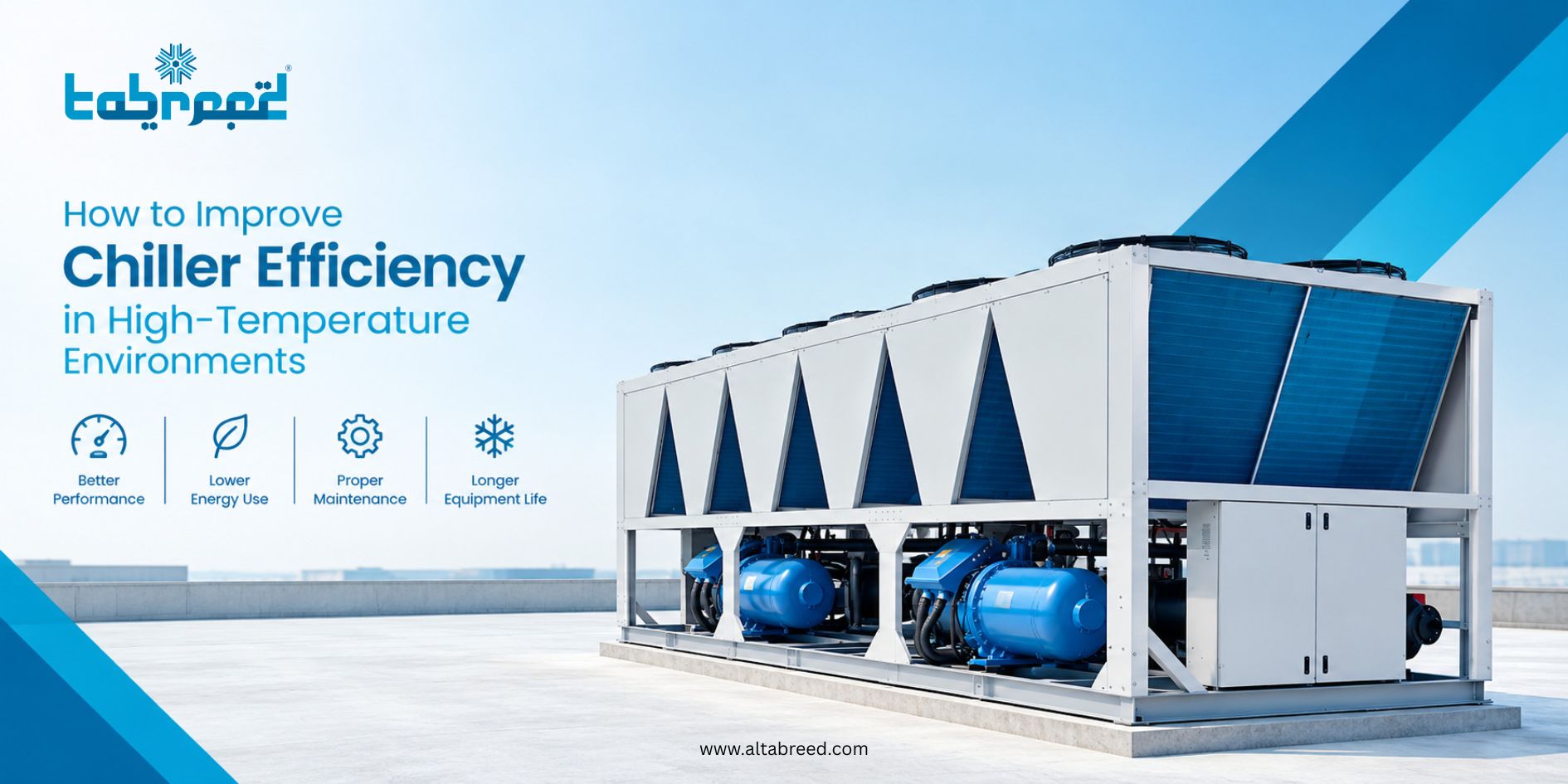
High ambient temperatures can significantly affect chiller efficiency. As outdoor temperatures rise, air-cooled chillers must reject heat to hotter air, increasing the temperature difference the refrigeration system must overcome. This can increase compressor power consumption and reduce cooling efficiency.
In the UAE and wider Gulf region, where extreme summer temperatures place sustained demands on cooling equipment, maintaining chiller performance is an operational priority.
The good news is that several common causes of efficiency loss can be addressed through appropriate maintenance, correct system sizing and performance monitoring.
Why Do Chillers Lose Efficiency in High-Ambient Conditions?
Chiller efficiency drops in high ambient temperatures because the condenser must work against a higher heat rejection temperature. The compressor has to raise refrigerant pressure higher to push heat into hotter ambient air or water & that takes more energy for the same cooling output.
Efficiency is measured as the coefficient of performance (COP): the ratio of cooling delivered to electrical energy consumed. A chiller running in 46°C ambient air is working in conditions its design point may only partially account for.
Research published by Khalifa University in 2018 highlighted the potential for climate-optimised chiller design in the UAE. The study reported a seasonal coefficient of performance (SCOP) of 3.8 for the Masdar City district cooling plant, while its modelled UAE-optimised air-cooled chiller design achieved an SCOP of 5.6, a 46% improvement in the model comparison. The findings demonstrate the potential benefits of designing cooling equipment around local climatic conditions.
This matters practically because chiller plants are typically the largest single electrical load in a commercial or industrial building. What happens at the condenser side…fouling, charge, airflow, water quality…directly determines where in that COP range your plant is operating.
Does Condenser Tube Fouling Actually Matter That Much?
Yes. Condenser tube fouling can be a significant cause of avoidable chiller efficiency loss, particularly in water-cooled systems. Scale, biofilm, mineral deposits and suspended solids can reduce heat transfer, forcing the refrigeration system to operate at higher condensing temperatures and pressures.
The resulting increase in compressor power depends on the severity of fouling, the chiller design and its operating conditions. Monitoring condenser performance and maintaining appropriate water treatment and cleaning schedules can help prevent unnecessary energy consumption.
A reliable early indicator is condenser approach temperature – the difference between leaving condenser water temperature and refrigerant condensing temperature. An approach drifting beyond the original design specification is signalling fouling, scale, or insufficient water flow. Track it continuously. Clean when the threshold is crossed, not on a calendar cycle that may be too infrequent or too aggressive.
How Does Part-Load Management Affect Efficiency?
Running chillers at part load is where plants lose efficiency most consistently. A chiller operating at full load is usually more efficient than two chillers at half load, but the relationship between load and efficiency is non-linear and depends on the machine type.
Full-load performance is not a good indicator of overall chiller plant performance because chiller plants rarely operate at full load. Part-load performance is the metric that governs real-world operating cost.
For plants with multiple chillers, staging decisions should be based on the performance characteristics of each unit and the overall cooling demand. Running one chiller at a higher load may be more efficient in some situations, while operating multiple units at partial load may be preferable in others. Reviewing manufacturer performance data and using appropriate controls helps identify the most efficient operating arrangement.
In high-temperature UAE operating conditions, mainly, where cooling loads remain elevated through extended summer periods, optimising staging and part-load operation has a direct and measurable impact on energy spend across the season.
What Maintenance Programme Protects Chiller Efficiency in the UAE?
Protecting chiller efficiency in high-temperature environments requires a maintenance programme that tracks performance metrics continuously…not just runs scheduled servicing on a calendar.
The key practices:
- Condenser approach temperature - Track continuously; clean tubes when it drifts beyond the design specification. Most OEMs require cleaning when the approach rises more than 3°F above original design.
- Water treatment - For water-cooled systems, treat condenser water to prevent scale, biological growth, and corrosion that drive fouling.
- Purge unit servicing - Scheduled maintenance on purge units to remove non-condensables before they accumulate.
- Refrigerant charge verification - Incorrect charge mimics fouling symptoms and wastes energy independently; verify charge regularly and check for leaks.
- Oil analysis - Lubricant condition is a direct indicator of compressor health; missed oil analysis intervals are one of the three leading causes of chiller failure.
- Airflow clearance for air-cooled units - Make sure condenser coil face area is not obstructed by dust accumulation, structural encroachment, or recirculation of hot discharge air.
What Does Al Tabreed Supply for Chiller Applications?
Al Tabreed Industries delivers specialized heat exchange and cooling equipment tailored for commercial HVAC and industrial duties throughout Oman and the UAE.
To support new projects, custom-designed water chillers are built at our Sharjah production plant for specialized technical and facility demands. For air-cooled installations, we also offer our dedicated TABREED NEXUS system lineup.
When operational plants suffer thermal degradation, replacement condenser coils and evaporator coils are engineered to mirror OEM parameters following engineering review. Additionally, we provide heavy-duty shell and tube heat exchangers for compatible industrial fluid loops.
If you are dealing with a chiller showing reduced performance in Gulf operating conditions, be it through coil degradation, fouling, or a system that was never properly specified for the ambient – contact our team today.