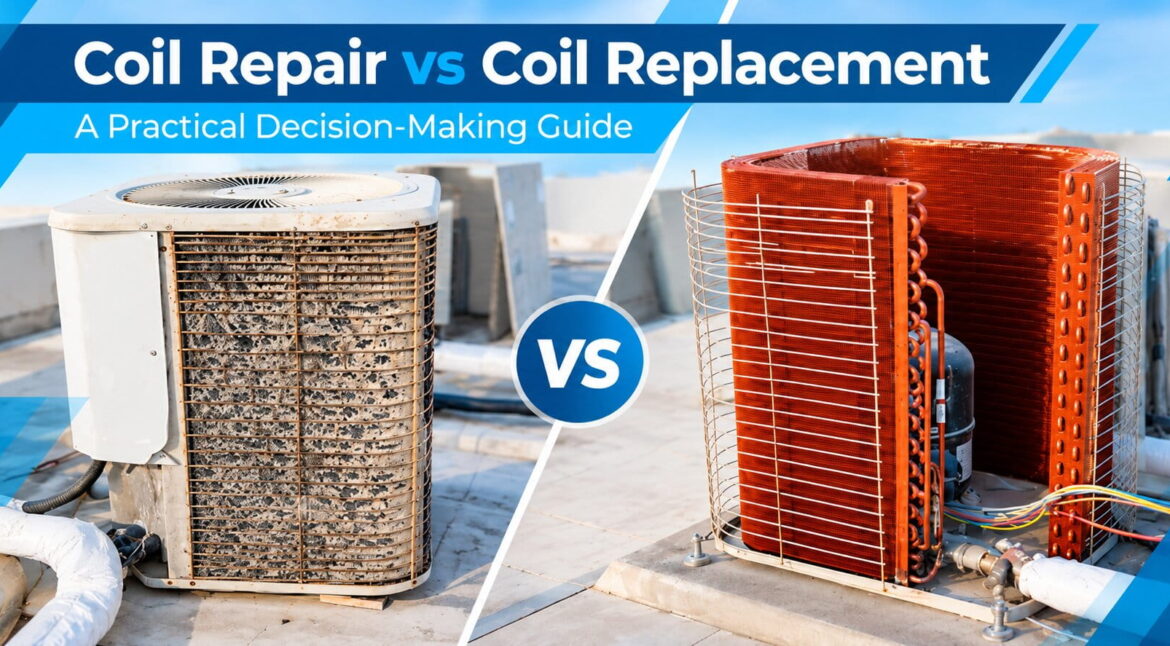
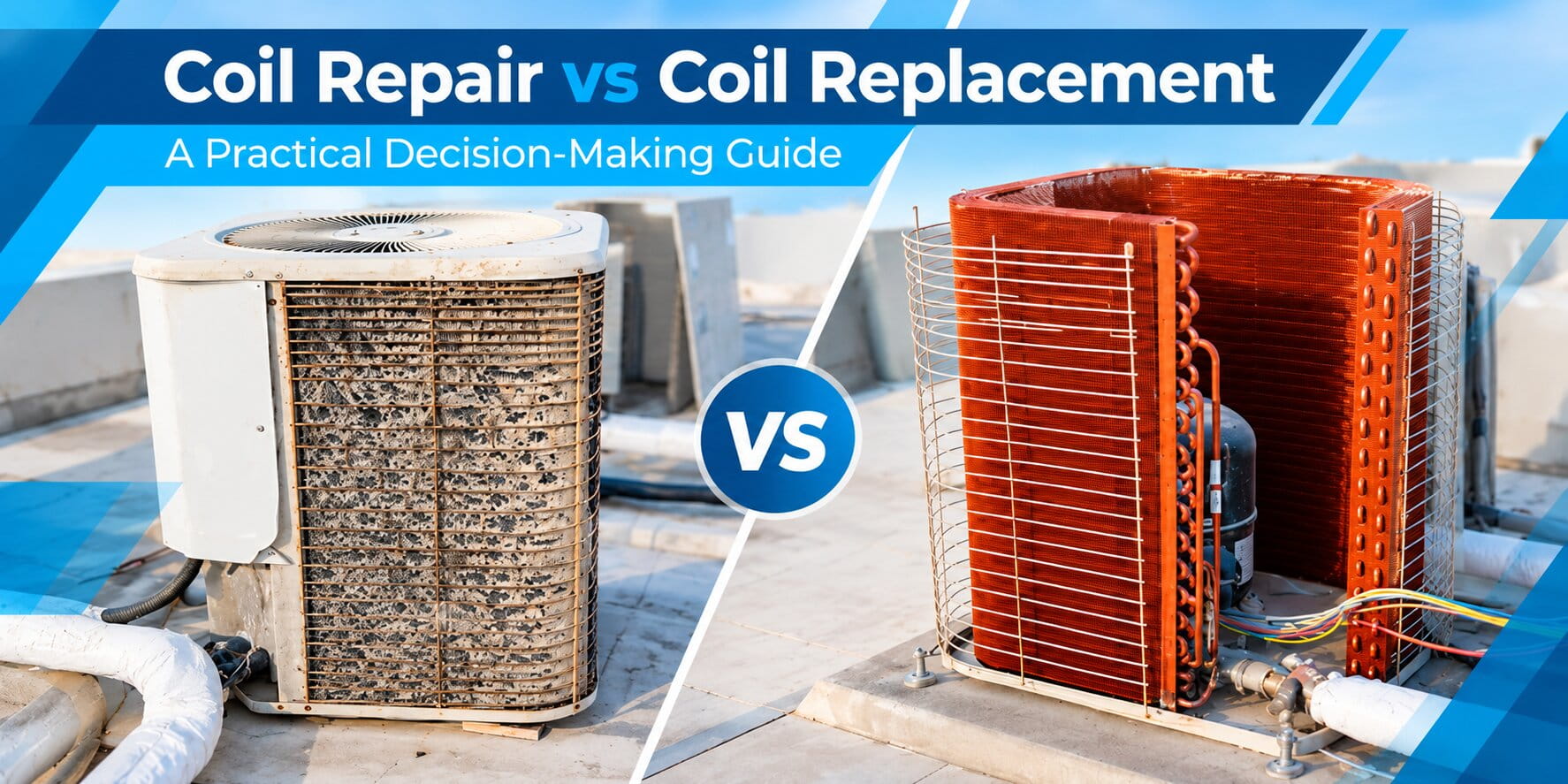
When a coil fails, the first question is always the same: fix it or replace it? It sounds straightforward. In practice, the decision is more nuanced than most facilities managers expect … and getting it wrong in either direction costs more than the repair or the replacement itself.
This guide is designed to help you make the right call.
When a Coil Can Be Repaired?
Not every coil failure means the coil is finished. There are genuine cases where a targeted repair is the correct response … faster, cheaper, and perfectly adequate for the life expectancy remaining in the coil.
Repair makes sense when:
- The damage is isolated to a single brazed joint or a small number of tubes
- The leak is in an accessible section of the coil ... not buried inside a packed AHU casing or behind inaccessible connections
- The fins, casing, and return bends are in good condition overall
- The coil has a relatively short service history and no prior repair record
- The rest of the system - the fan, casing, connections, and controls - is functioning well
- Cooling capacity loss is minimal or undetectable in performance readings
A single pinhole leak at a return bend, for instance, is a routine repair. The cause is usually a combination of vibration fatigue and corrosion at the joint. Re-brazing with proper nitrogen purging resolves it cleanly in most cases.?
When Replacement Is the Safer Long-Term Option
There is a point at which repairing a coil stops being a maintenance decision and starts being a liability. The risk isn’t the current repair … it’s the next failure. And the one after that.
Replacement is the right call when:
- Multiple leaks have been found across different sections of the coil
- The tubes show widespread wall thinning or internal pitting - signs of generalised deterioration rather than isolated damage
- The fins are significantly corroded, collapsed, or blocked - reducing heat transfer efficiency regardless of whether the leak is fixed
- Return bends are showing cracking or corrosion at multiple points
- The coil casing is distorted or corroded to the point where it no longer seals properly against the unit
- The coil has already been repaired once or twice - each subsequent repair on an aging coil carries a higher risk of failure elsewhere
- The original coil is no longer available from the manufacturer. This means any future replacement will require custom fabrication anyway
- Cooling capacity has dropped measurably and cannot be explained by fouling alone
In UAE and Gulf operating conditions specifically, widespread tube deterioration tends to accelerate faster than in more temperate climates. A coil that has been in continuous service for several years under high ambient temperatures and coastal humidity will show internal degradation that isn’t always visible externally. Pressure testing alone won’t catch tube wall thinning until it becomes a leak.
Also Read: How Sand, Dust, and Humidity Affect Coil Performance in the Middle East
Isolated Leak vs Widespread Deterioration
This is the critical distinction and it requires a proper assessment … not a visual check alone.
An isolated leak is a single failure point in an otherwise sound coil. The tube walls are intact elsewhere. The fins are in reasonable condition. The return bends are not cracking. This coil has life left in it and a targeted repair is defensible.
Widespread tube deterioration is a different situation entirely. Pitting corrosion, internal scaling, multiple wall-thin areas, or generalised corrosion across the fin block all indicate a coil that is failing systemically … not at one point. Repairing the visible leak here is treating a symptom. The next leak is already developing.
The only reliable way to distinguish between the two is a combination of pressure testing, visual inspection of the fin block condition, and where accessible, internal tube inspection. In cases of doubt, it is worth requesting a full assessment before committing to either path.
Factors to Assess Before Deciding
Go through each of these before making the call:
Condition of Fins
Are they intact and cleanly spaced, or collapsed, corroded, and clogged? Blocked fins reduce heat transfer efficiency regardless of tube condition. If the fin block is severely degraded, repair of the tubes alone won’t restore performance.
Tube Condition
Is wall thinning visible or measurable? Are multiple tubes showing corrosion? One compromised tube is a repair. A pattern across the coil is a replacement.
Casing and Return Bends
Return bends are one of the most common failure points … they take the stress of thermal expansion and contraction with every cycle. Cracking at one return bend in an older coil usually means others are close behind. Check all of them.
Accessibility of the Damaged Area
A leak in an exposed, easy-to-reach section of the coil can be re-brazed without removing the coil entirely. A leak buried deep inside a tightly packed AHU requires full removal to repair properly – at which point the labour cost of repair approaches or exceeds the cost of fitting a replacement while the coil is already out.
Age and Repair History
A coil in its first two or three years of service with no prior repairs is a repair candidate. A coil that has been in service for five or more years in UAE conditions with one or two previous repairs is a replacement candidate … even if the current failure looks minor.
Original Coil Availability
If the original manufacturer no longer supplies the coil … or if lead times on imported parts run to weeks … a locally manufactured replacement from Al Tabreed is often faster and more cost-effective than waiting on a repair part that may not arrive in time.
Loss of Cooling Capacity
This is an indicator that doesn’t get enough attention.
A coil that is leaking refrigerant loses capacity gradually and often silently before the leak becomes obvious. By the time the failure is diagnosed, the system may have been running at reduced efficiency for weeks. If the capacity loss is significant … measurable in the system’s performance data – it is worth factoring into the repair-or-replace decision.
A repaired coil that has lost 15 to 20% of its effective heat transfer area due to fin damage or tube fouling will never recover that capacity through repair alone. Replacement is the only path back to original performance.
Also Read: Bus Air Conditioner Condenser and Evaporator Coils for HVAC Systems
Repair Cost vs Repeat-Failure Risk
The financial case for repair is straightforward on paper: repair costs less upfront. But that calculation only holds if the repair actually extends the coil’s useful life.
The real question is: what is the probability of another failure within 12 months?
For a coil showing widespread deterioration in a UAE environment, that probability is high. The cost of a second emergency callout, including technician time, refrigerant recharge, system downtime, and disruption to the building or process, can quickly exceed the cost of a replacement that would have prevented it.
Repair when the failure is isolated and the coil has remaining life. Replace when the evidence suggests the coil is in systemic decline.
Information Needed to Manufacture a Replacement
If replacement is the right call, the faster you can get accurate information to your coil manufacturer, the faster the replacement arrives.
Manufacturers need the following to manufacture a direct replacement:
- Physical dimensions: face width, face height, and depth (number of rows)
- Tube diameter and tube spacing (if known)
- Fin spacing (fins per inch or fins per centimetre)
- Number of circuits and circuit configuration
- Connection sizes and positions (inlet and outlet)
- Refrigerant or fluid type
- Operating pressure requirements
- The failed coil itself, if available for direct measurement
- Original drawings or OEM data, if available
In many cases, the failed coil arriving at our Sharjah facility is sufficient. We measure, manufacture, pressure test, and dispatch … without dependency on the original equipment manufacturer.
Repair or Replace: A Simple Checklist
Run through this before making the decision:
Question | Verdict |
Is the damage limited to a single, clearly identified failure point? | Repair |
Are multiple leaks or deterioration signs present across the coil? | Replace |
Are fins, casing, and return bends in good condition? | Repair |
Is the damaged area easily accessible without full coil removal? | Repair |
Has the coil been repaired before? | Lean toward replacement |
Is the coil more than five years old in continuous UAE service? | Lean toward replacement |
Has measurable cooling capacity been lost? | Replace |
Is the original coil unavailable from the manufacturer? | Replace |
Does the repair cost approach the cost of a new coil when labour is included? | Replace |
If three or more answers point toward replacement, that’s the right call.
The Takeaway
At Al Tabreed Industries LLC, we help facilities managers, HVAC contractors, and engineering teams work through exactly this decision … without pushing toward replacement when repair is the right answer, and without allowing a compromised coil to remain in service when it shouldn’t. We manufacture replacement coils for AHUs, FCUs, DX systems, cold rooms, and refrigeration applications across Dubai, Sharjah, and Oman.
If you have a coil that has failed or is showing signs of deterioration, send us the details and we will give you an honest assessment alongside a quote for a replacement if that’s what the situation calls for. Contact today or visit our condenser coil manufacturer page to know more.