A chiller that was performing well twelve months ago is now struggling. The compressor runs longer. Energy bills rise. Holding set-point becomes harder, particularly during the hottest part of the day.
The cause is not always a major breakdown. Fouling, refrigerant problems and unsuitable operating settings can gradually reduce cooling capacity and increase the power needed to deliver it.
In UAE and Gulf operating conditions, prolonged heat and demanding duty cycles make those losses harder to ignore. For facility managers and MEP teams, the priority is to identify what has changed before deciding what needs fixing.
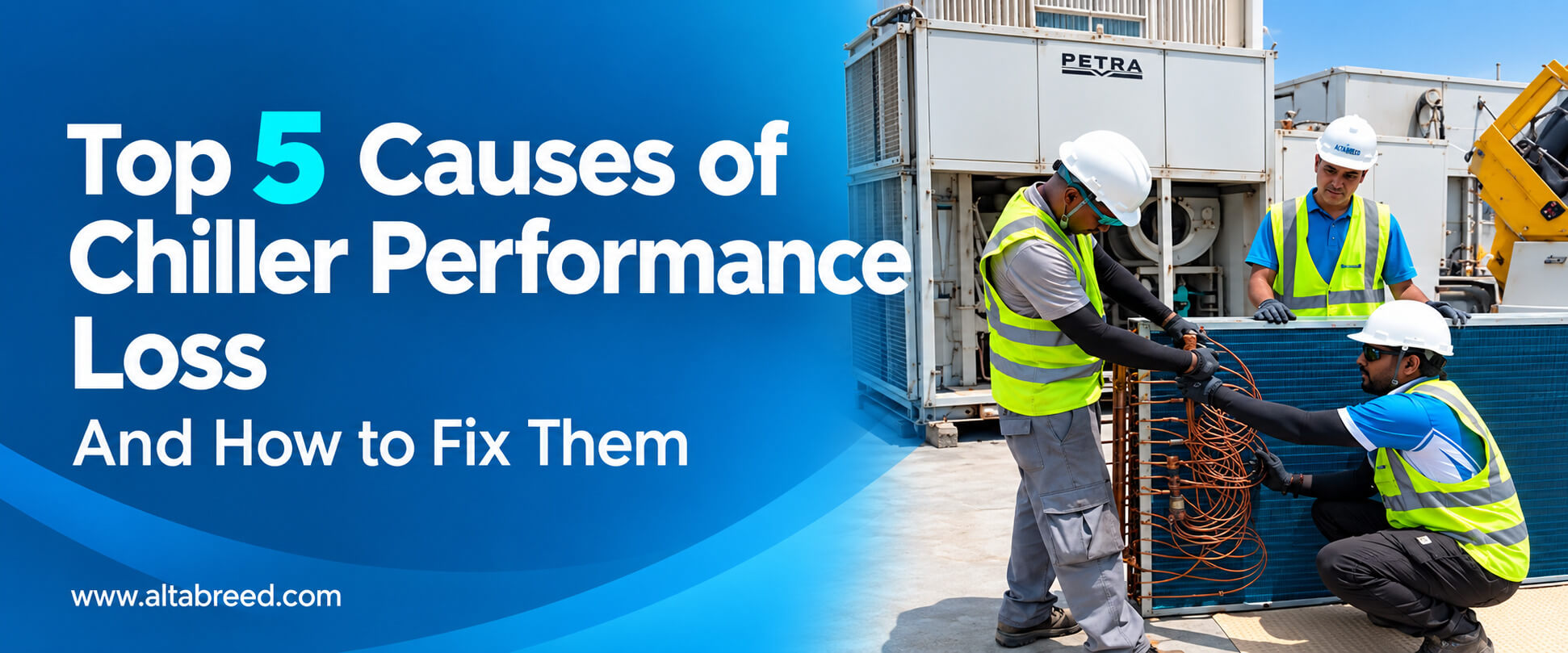
Here are five common causes of chiller performance loss, and what to do about each one.
Before You Start: Check the Baseline
Higher energy use alone does not prove that a chiller has become less efficient. Hotter weather, increased cooling demand or a lower chilled-water set-point can all change its operating conditions.
Compare current readings with a clean, correctly commissioned baseline at similar load and temperatures. Check chilled-water flow, entering and leaving water temperatures, electrical input and relevant refrigerant readings. Where cooling output is reliably measured, track kW per refrigeration ton or COP rather than compressor current alone.
For broader operating guidance, read How to Improve Chiller Efficiency in High-Temperature Environments.
1. Condenser Tube Fouling
In water-cooled chillers, scale, suspended solids and biological deposits can accumulate on the water-side surfaces of condenser tubes. They act as insulation. Heat transfer deteriorates, condensing temperature rises, and the compressor has to work harder.
The machine may still hold temperature for a time. The first visible change can be the energy needed to do it.
The fix: Track condenser approach temperature against the clean baseline at comparable conditions. For a typical water-cooled condenser, this is the saturated refrigerant condensing temperature minus the leaving condenser-water temperature. Trane’s chiller-efficiency guidance explains how approach affects compressor lift.
A rising approach warrants investigation, but does not prove fouling. Check water flow, sensor accuracy and refrigerant condition before selecting a remedy. If inspection confirms deposits, use an OEM-approved cleaning method and review water treatment alongside cooling-tower maintenance. Condition monitoring should support the manufacturer’s servicing schedule.
2. Non-Condensables in the Refrigerant Circuit
Air in the refrigerant circuit can accumulate in the condenser, raising pressure and reducing the system’s ability to reject heat efficiently. The compressor works harder, while available cooling capacity can fall.
Low-pressure chillers are particularly relevant here because parts of the circuit can operate below atmospheric pressure, allowing air to enter through leaks. Contamination may also follow unsuitable servicing. Moisture is a related but separate concern that requires assessment under the manufacturer’s procedures.
The fix: On chillers equipped with a purge system, maintain it and review its operating history. Unusual purge activity can indicate a need to investigate inward leakage. Trane’s CenTraVac maintenance manual explains the purge requirements for the applicable machines.
Other chiller designs require their own contamination checks and removal procedures. In every case, address the entry path as well as the contamination. Removing air without correcting the underlying problem leaves the loss likely to return.
3. Refrigerant Charge Errors
An incorrect refrigerant charge can reduce chiller performance and produce symptoms that resemble other faults.
Undercharge can reduce cooling capacity. Overcharge can increase condensing pressure and interfere with normal operation. When fouling, flow problems or charge errors occur together, the readings become harder to interpret.
That is why reduced cooling should not automatically lead to another refrigerant top-up.
The fix: Have a qualified technician verify charge using the manufacturer’s procedure. Depending on the design, assessment may include pressures, temperatures, refrigerant level, and superheat or subcooling where applicable.
If charge has been lost, investigate and repair the leak before restoring the specified amount. If the problem follows servicing, check the work against the equipment requirements. Recheck performance under stable conditions afterwards; adding refrigerant alone does not establish that the fault has been resolved.
4. Condenser Coil Fouling and Airflow Problems
For air-cooled chillers, the condenser depends on a reliable supply of outdoor air. Dust and debris can obstruct coil passages, damaged fins can reduce effective heat transfer, and fan faults can restrict airflow.
Hot-air recirculation creates another problem. A clean coil can still struggle if it is drawing in its own discharge air because of nearby structures or restricted clearances.
Coastal exposure can add corrosion to the picture. Our guide to sand, dust and humidity affecting HVAC coils explores these Gulf conditions in more detail.
The fix: Inspect coil condition, fans, clearances and discharge paths. Compare condenser inlet-air temperature with the surrounding outdoor air to help identify recirculation. Follow the cleaning procedure for the actual coil construction, including fin-and-tube or microchannel designs.
Where inspection identifies extensive corrosion, repeated leakage or physical deterioration, assess coil repair versus replacement. Cleaning removes deposits; it cannot restore metal already lost to corrosion. A replacement must match the equipment and operating duty, with other system faults addressed as well. Al Tabreed manufactures replacement condenser coils for UAE operating conditions, including fin surface options suited to coastal and high-humidity environments.
5. Poor Part-Load Management
A chiller running at partial load is not necessarily running inefficiently. The result depends on the machine, operating temperatures and how the plant manages demand.
There is no universal rule that one chiller at full load will outperform two at half load. Some machines perform efficiently at reduced load; other arrangements incur unnecessary compressor, pump or cooling-tower energy.
In UAE plants moving between summer peaks and lower seasonal loads, staging decisions can influence operating cost throughout the year.
The fix: Review actual load profiles, cycling, set-points and BMS overrides against manufacturer performance data. Compare total plant power, including pumps and tower fans, rather than the chiller alone. Trane’s part-load evaluation guidance supports evaluating performance under the conditions that matter to the installation.
Adjust controls while maintaining required flow, stable operation and the temperatures the application needs. Assess variable-speed upgrades against the equipment and duty rather than assuming a fixed saving.
When Performance Loss Points to a Replacement
ese five causes provide a starting point. Persistent problems can also involve evaporator fouling, water-flow restrictions, compressor wear or a cooling load that has outgrown the original selection. Where the required duty has changed, revisit the industrial chiller specification before choosing new equipment.
For many customers contacting Al Tabreed, the coil fault is already established. In one recent enquiry, a customer reported leakage and requested a replacement. Our site inspection confirmed that the existing coil was leaking and deteriorated. Once the problem is confirmed, the priority is a replacement suited to the equipment and operating conditions.
Al Tabreed manufactures and supplies replacement condenser coils, evaporator coils, and industrial chillers, with site inspection and installation support available. If your coil is leaking, deteriorated or needs replacing, contact our team. Share any available photographs, dimensions or drawings, and we will guide you on the next steps.
Call: +971 55 817 1170
Email: sales@altabreed.com
Frequently Asked Questions
Compare condenser approach with the clean baseline at similar operating conditions. A rising approach can indicate fouling, but water flow, sensor accuracy and refrigerant condition should also be checked before deciding that cleaning is required.
Some low-pressure chillers use a purge system that operates during normal running. This does not apply to every chiller. Follow the manufacturer’s procedure for the specific machine and investigate the source of contamination.
Replacement may be appropriate where extensive corrosion, repeated leakage or structural damage makes repair unsuitable. Confirm the coil’s condition and replacement requirements first. Our coil failure and prevention guide covers related deterioration risks.