

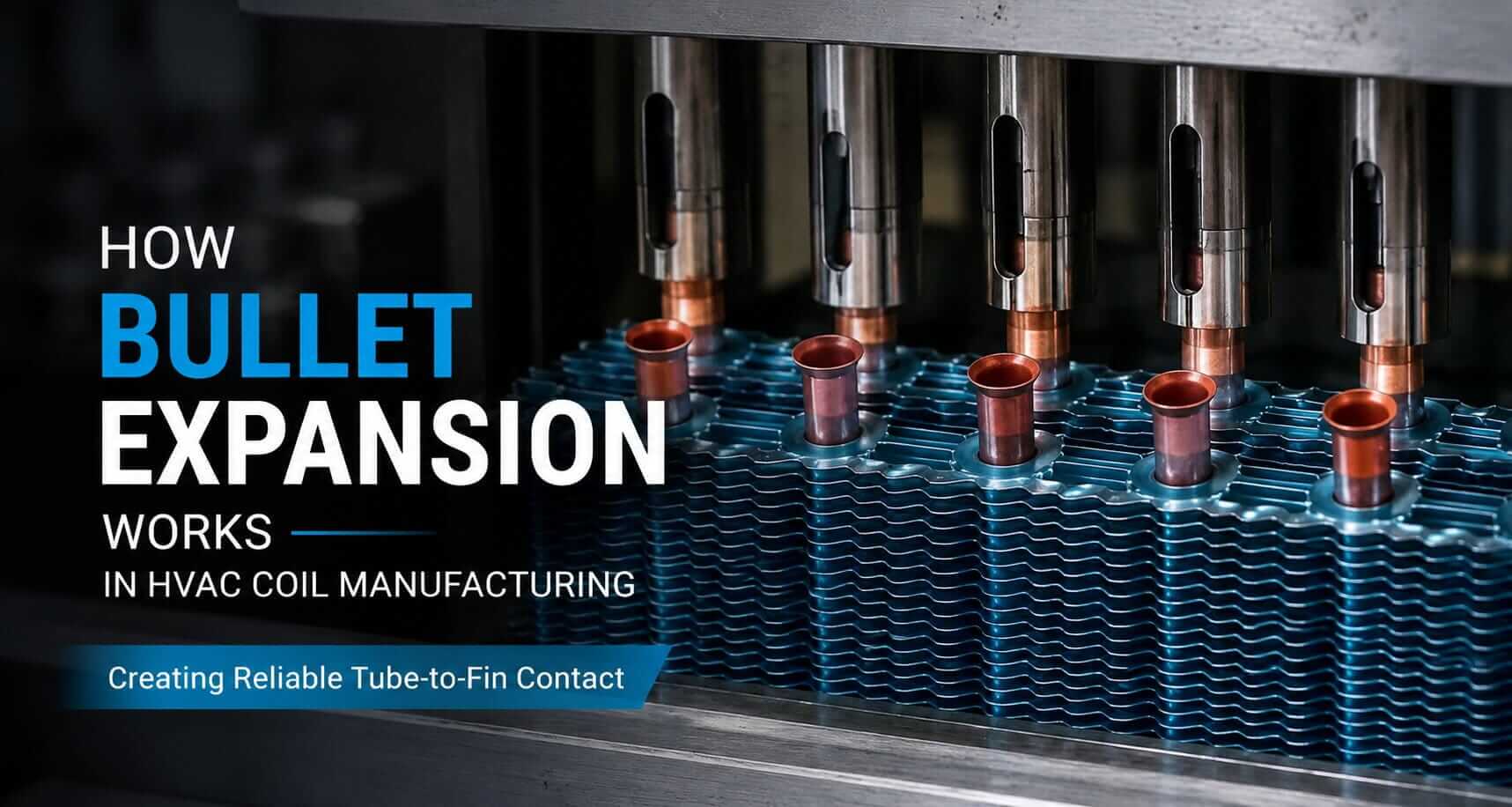
When you look at a finished condenser coil, everything looks neat and uniform. Tubes running parallel, fins stacked evenly, the whole assembly looking like it came together easily. What you don’t see is one of the most critical steps in the entire manufacturing process … bullet expansion.
Get this step right, and the coil transfers heat efficiently for years. Get it wrong and the coil underperforms from day one … even if everything else was done perfectly.
What Is Bullet Expansion?
Bullet expansion … also called mechanical tube expansion … is the process of enlarging the diameter of copper tubes after they’ve been threaded through the fin stack.
A hardened steel tool called a bullet … or mandrel … is pushed or pulled through each tube. As it passes through, it forces the tube wall outward. The copper expands against the inner edge of the fin collar, creating a firm, continuous mechanical bond between tube and fin.
That bond is what makes heat transfer happen efficiently. Without it, you just have tubes sitting loosely inside holes in a fin stack … and that gap, however small, acts as an insulating barrier.
Why Tube-to-Fin Contact Matters So Much
Heat doesn’t jump across gaps. It conducts through solid contact.
The entire purpose of the aluminium or copper fins in a coil is to extend the surface area available for heat exchange. But fins can only do that job if they’re in proper contact with the tubes carrying the refrigerant.
When bullet expansion is done correctly:
- The fin collar wraps tightly around the tube outer wall
- There are no air gaps between tube and fin
- Heat flows freely from refrigerant - > tube wall - > fin - > airstream
- The coil delivers the performance it was designed for
- Air pockets form between tube and fin
- Thermal resistance increases
- The coil works harder to achieve the same cooling effect
- Energy consumption rises and system efficiency drops
In a residential AC unit this might show up as slightly higher electricity bills. In an industrial chiller or large AHU … the performance gap is significant and the operating costs add up fast.
Also Read: Why Copper Tube – Aluminium Fin Coils Perform Best in the Gulf
How the Bullet Expansion Process Works
The process of how bullet expansion works is more controlled than it sounds.
- Tube and fin stack assembly:- Fins are stacked at the required spacing onto the tube bundle. At this stage the tubes pass loosely through the fin collars ... the fit is intentionally loose to allow threading.
- Bullet sizing:- The bullet or mandrel is selected based on the tube's outer diameter and the required expansion rate. Different tube sizes require different bullets. Using the wrong size risks under-expansion or over-expansion - both are problems.
- Expansion Pass:- The bullet is driven through each tube using hydraulic or mechanical force. The copper wall deforms outward uniformly, pressing firmly against the fin collar along the entire tube length.
- Verification:- After expansion, the coil is checked for uniform contact, fin spacing integrity, and any signs of tube splitting or fin collar damage.
- Expansion Pass:- The bullet is driven through each tube using hydraulic or mechanical force. The copper wall deforms outward uniformly, pressing firmly against the fin collar along the entire tube length.
Problems Caused by Incorrect Expansion
This is where many lower-quality coils fail silently.
- Under-expansion:- the tube doesn't fully contact the fin collar. Air gaps remain. Heat transfer efficiency is compromised immediately. The coil will never perform to its rated capacity.
- Over-expansion:- the copper tube wall is stretched too thin in places. This weakens the tube, increases the risk of micro-cracks, and can lead to refrigerant leaks down the line. Over-expansion can also distort fin collars and damage fin spacing.
- Uneven expansion:- can happen when bullets wear out or hydraulic pressure varies. Some sections of the tube make good contact while others don't. The result is a coil with inconsistent performance across its face area.
- Tube splitting:- a more serious failure that occurs when expansion force is too high or the copper quality is poor. The tube cracks during expansion ... a defect that must be caught at inspection, not after installation.
How Expansion Differs Across Tube Sizes and Coil Constructions
Not all coils are expanded the same way.
Smaller diameter tubes – common in high-efficiency residential coils and FCU coils – require more precise control during expansion. The tube wall is thinner relative to its diameter, so there’s less margin for error.
Larger diameter tubes used in industrial chillers and large AHU coils handle expansion more easily but require higher force to achieve consistent contact across the full tube length.
Coil depth also tends to matter. A coil with multiple rows of tubes requires the bullet to pass through each row independently. Maintaining consistent expansion across all rows … without progressively distorting the fin stack … takes experience and well-maintained tooling.
All-copper coils, copper tubes with copper fins, behave slightly differently from copper-aluminium coils during expansion. Copper fin collars are less forgiving than aluminium ones. The process requires calibrated force and well-maintained bullets to avoid collar cracking.
Conclusion
At Al Tabreed Industries LLC, bullet expansion is a controlled, verified step in every coil we manufacture … whether copper-aluminium or all-copper construction. Our coils are built for the demands of UAE and Gulf environments … where heat transfer efficiency and long service life aren’t optional.
Contact us today to discuss your coil requirements.
Frequently Asked Questions
Not always from the outside - but a trained eye can spot signs of poor expansion such as fin distortion, uneven collar contact, or visible gaps. Proper inspection involves checking contact consistency across the full coil face.
Yes. Over-expansion thins the tube wall and can reduce its pressure capacity. This is why expansion rates are controlled to specification rather than maximised.
Bullets wear with use and a worn bullet produces inconsistent expansion. Reputable manufacturers inspect and replace tooling on a regular schedule ... not just when problems become visible.