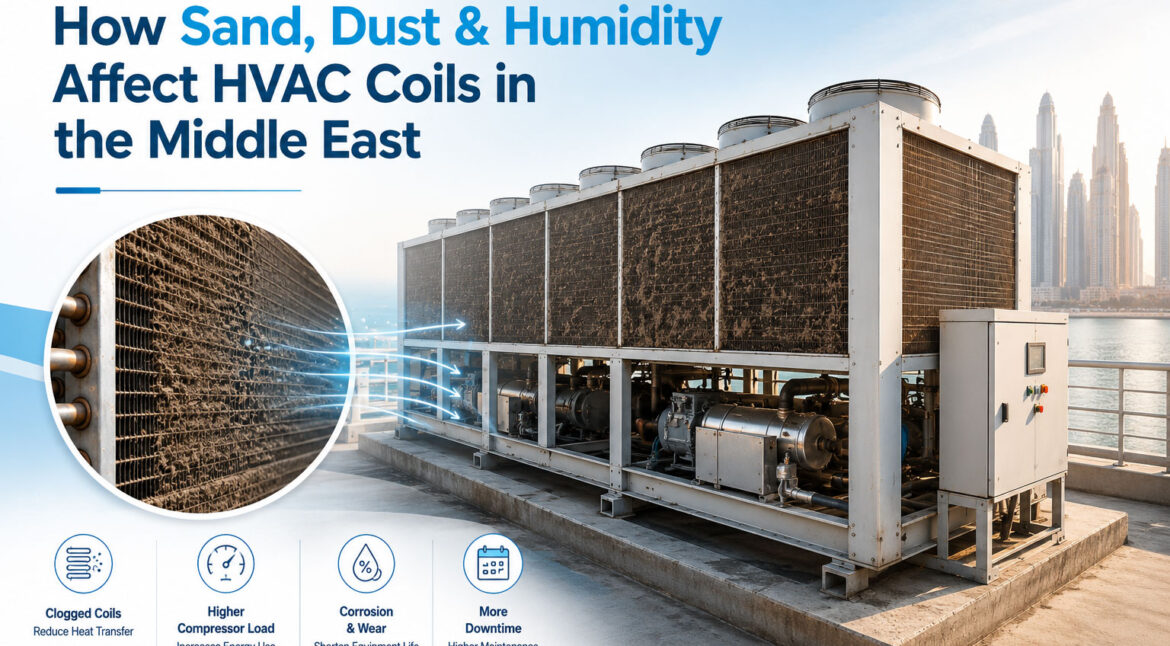
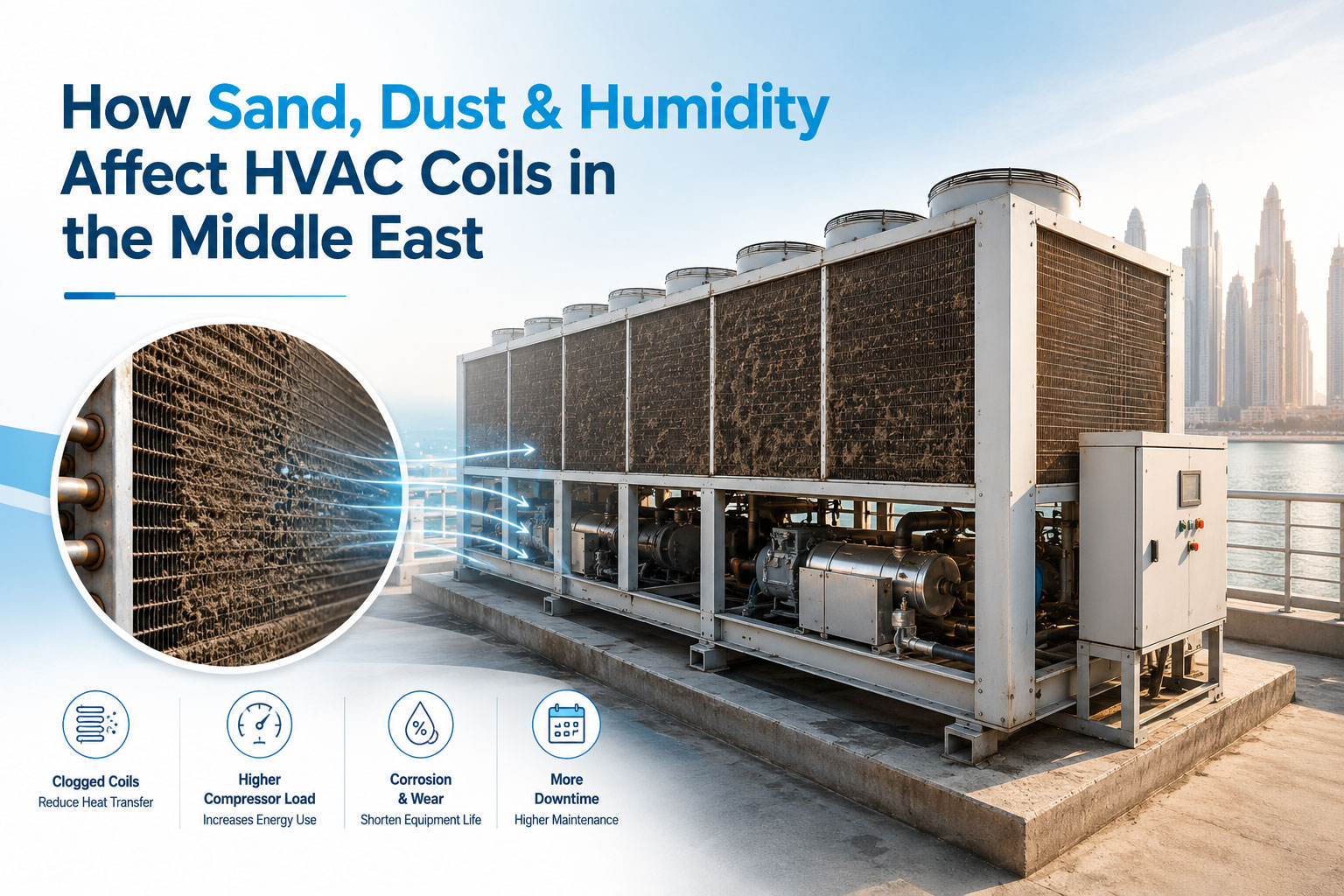
Every condenser coil installed in the Gulf is fighting a war it never signed up for. Fine desert sand rides on prevailing winds and settles into fin gaps. Construction dust from a dozen nearby sites adds to it. Then humidity, particularly in coastal areas, adds another problem: moisture can cause fine particulate to adhere more firmly to the fin surface rather than remaining as loose, dry dust. .
None of this is exotic or rare. It is simply the operating environment. This helps explain why coils operating in Gulf conditions may require more frequent inspection and cleaning than similar equipment operating in cleaner, milder environments.
The Mechanism: How a Blocked Coil Becomes a System Problem
The chain of cause and effect here is straightforward once you follow it through, and it is worth following all the way to the end rather than stopping at “the coil got dirty.” Dust and sand accumulate on the fin surface and between fin gaps, physically narrowing the passages air needs to move through.
Airflow across the coil decreases as resistance through the fin passages increases. Depending on the fan and control system, the fan may operate against a higher pressure drop while the actual airflow through the coil falls. With less air moving across the tube bank, the coil rejects heat less effectively, which means condensing temperature rises to compensate.
A higher condensing temperature increases the pressure differential the compressor has to work against, so compressor power draw increases just to maintain the same cooling output. The net effect is that chiller efficiency falls…often measurably, in kW per ton of cooling – long before anyone notices a drop in comfort or process temperature.
Left unaddressed, this progression ends in one of three places: a cleaning cycle, a coil repair, or, in cases of prolonged neglect and corrosion, a full coil replacement.
Why Sand Behaves Differently From Ordinary Dust
Not all particulate fouling is equal, and this is where the Gulf environment diverges from what coil manufacturers elsewhere typically design against. Fine silica sand is abrasive as well as obstructive; it can wear at protective coatings on fin edges over repeated exposure, not just block airflow. Combine that with humidity swings and the sand starts to bond rather than sit loosely, forming a crust that a simple air-blow cleaning struggles to shift.
Humidity’s Second Job: Corrosion Alongside Fouling
Humidity does not only help particulate stick. Along coastal UAE cities in particular, moist air carries a chloride load that accelerates corrosion on unprotected aluminium fins and copper tubes.
A coil already running hotter because of airflow restriction is now also degrading structurally, and the two problems compound each other…corrosion roughens the fin surface, which gives fouling more to grip onto, which restricts airflow further.
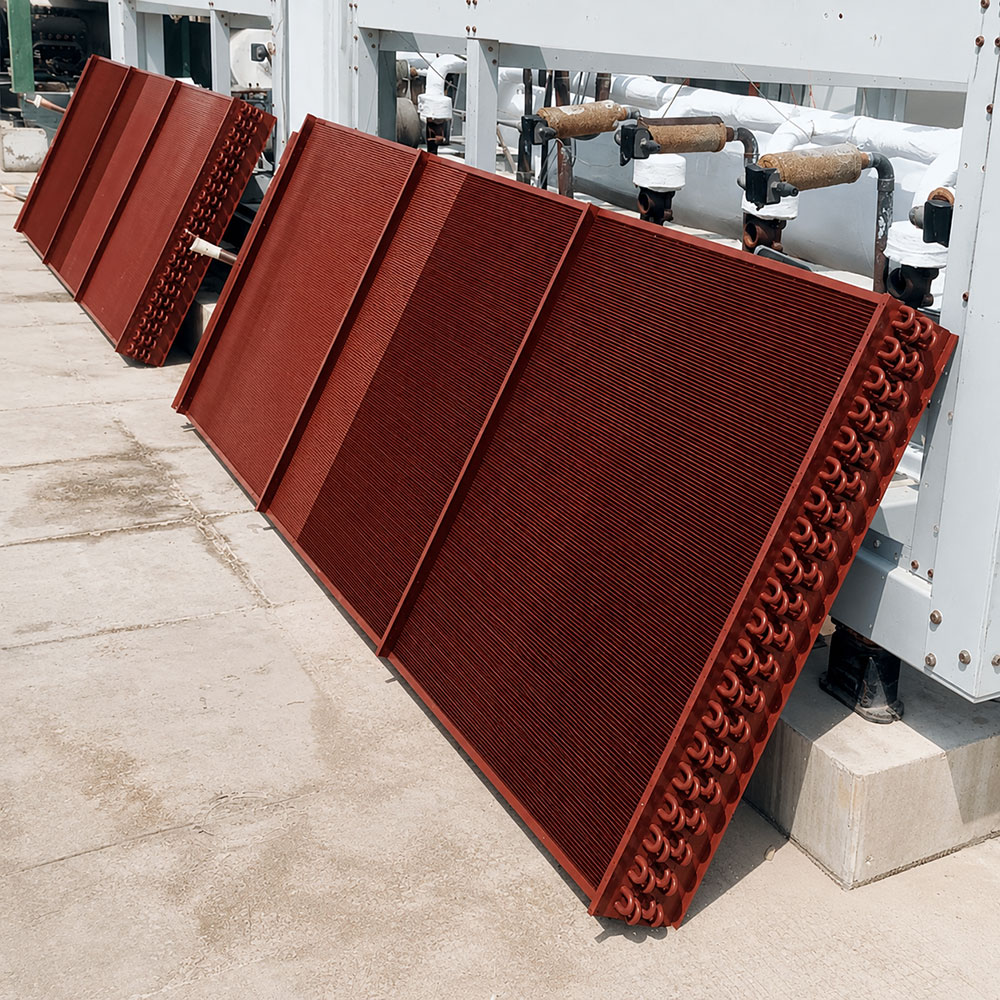
This is part of why coating specification (epoxy, Heresite, or equivalent) matters as much in coastal Gulf installations as fin geometry does; it is addressing a different failure mode that happens to be running in parallel with the fouling problem.
It is worth being specific about where this shows up operationally, because “reduced efficiency” can sound abstract until it hits a maintenance budget or an energy bill. In an industrial chiller, a fouled condenser coil forces the compressor to work against a higher head pressure continuously, which raises electrical draw for the same tonnage delivered…this is measurable on amp readings well before a technician physically inspects the coil.
Sustained operation at elevated condensing temperatures can also place additional thermal and mechanical stress on the compressor and associated components. And once fouling reaches a point where standard cleaning cannot restore airflow, the facility is looking at coil replacement…a considerably larger cost than the maintenance that would have prevented it.
Conclusion
Sand, dust, and humidity are not background conditions in Gulf HVAC systems, they are active variables that degrade coil performance and, through a direct and traceable chain, chiller efficiency.
Understanding that chain changes how the problem gets managed: not as an occasional cleaning task, but as a design and maintenance decision with a measurable effect on compressor load, energy cost, and equipment lifespan.
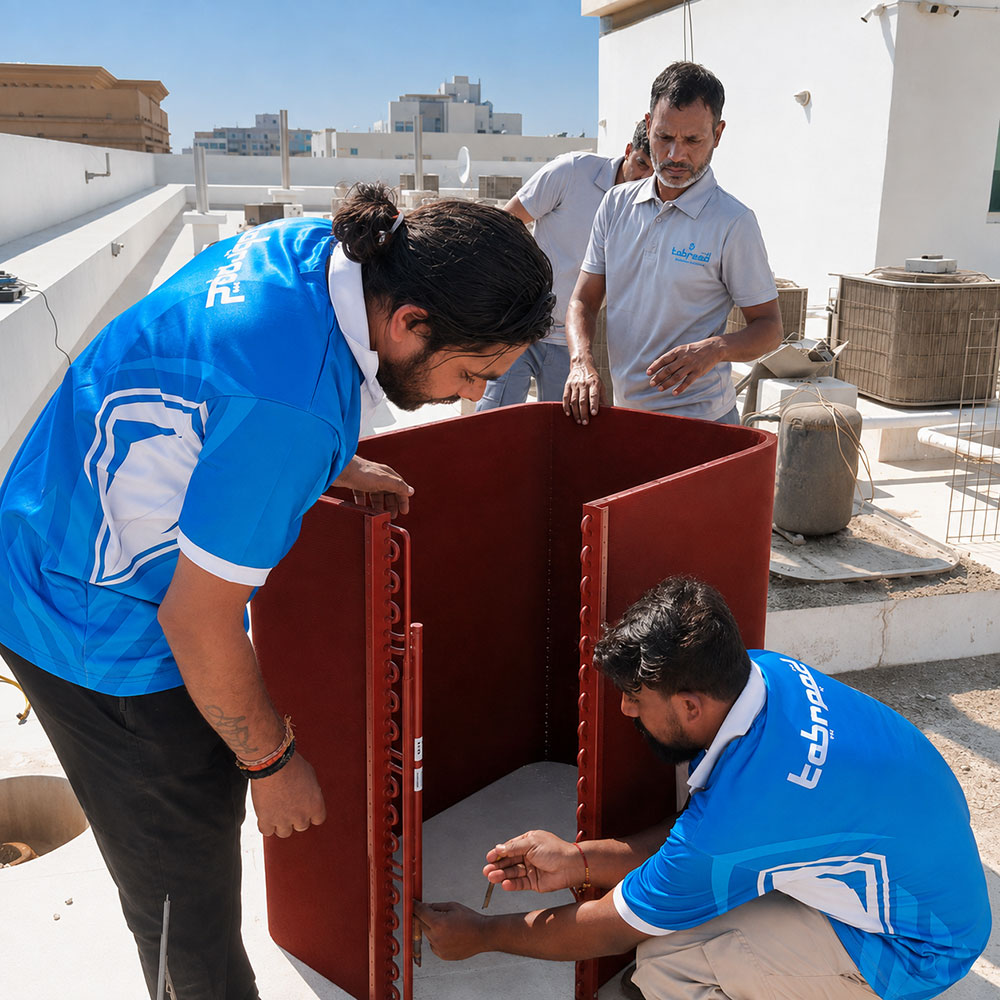
Al Tabreed Industries designs and manufactures condenser coils engineered for GCC dust, humidity, and heat conditions: get in touch to discuss fin spacing, material selection, corrosion protection,and coil configuration based on your site’s operating conditions. You can also explore our full range of cooling solutions